Home / Investor / Corporate Governance
Corporate Governance
Find information about Flügger groups A/S’ policies regarding corporate governance, stakeholder and investor relations, taxes, and climate and environment.

Corporate Governance at Flügger
The full Corporate Governance report is unfortunately only available in Danish. However, you can find a summary in English below.
As part of a company’s disclosure obligations, NASDAQ OMX Copenhagen requires listed Danish companies to account for how they address the “Recommendations for Corporate Governance” prepared by the Corporate Governance Committee.
The Flügger group A/S’ board of directors has reviewed the recommendations. Generally, Flügger follows the recommendations, but there are a few exceptions:
- Flügger group A/S publishes quarterly statements but not financial reports. Biannually reports are considered more appropriate due to a seasonal business resulting in high volatility in earning and margins on a quarterly basis, which potentially could be considered misleading.
- The Nomination and remuneration committee is not only comprised by members of the board of directors of which the majority are independent. As a result of prioritizing the committee’s competences, one member and the chair of the committee, Ulf Schnack, is a part of the executive management. Ulf Schnack is the main shareholder and Chief DNA Officer of Flügger group A/S.
- The board of directors completes an annual evaluation of their work, however Flügger has chosen not to involve external assistance for the evaluation every third year, as the evaluation process in itself is considered sufficient.
Stakeholder & IR policy
Flügger has approved a Stakeholder and Investor Relations Policy. The purpose is to define the overall framework for stakeholder and investor relations activities in Flügger.
Purpose
The goal of Flügger’s stakeholder and IR activities is clear: to provide market participants with a realistic and up–to–date picture of Flügger as an investment case.
In order to achieve this, we provide existing and potential investors, the media, and analysts with factual, relevant and comprehensive information about the group’s business and financial performance.
Activities
Stakeholder and IR activities specifically include dialogue with the stock market through company announcements, responses to enquiries, and participation at the annual general meeting. Furthermore, Flügger aims to communicate in an accessible, proactive and open manner.
In addition, the company complies with the current legislation and disclosure rules for listed companies on NASDAQ OMX Copenhagen.
Quiet Period
During the last four weeks before publishing financial statements or other price-sensitive announcements, Flügger observes a quiet period. Consequently, the company limits dialogue with market participants to ensure equal access to information in this specific period
Flügger Group - Tax Policy
Flügger’s Tax Policy describes our approach to taxes, transfer pricing, relationships with tax authorities, tax incentives, and governance.

Accountability & Transparency
View more less
Flügger intends to pay the taxes expected by legislators and mandated by law. Flügger seeks transparency and accountability in taxation to comply with applicable tax legislation and adhere to best practices in the tax field.
Flügger supports international initiatives aimed at creating the necessary transparency, including those aligned with the UN’s Sustainable Development Goals related to taxation and Flügger’s strategic sustainability initiatives. Flügger aims to be transparent in taxation, ensuring that its tax arrangements remain clear and justifiable at all times.

Approach to Tax
View more less
Flügger does not support nor engage in activities that, to Flügger’s knowledge, involve money laundering, tax evasion, or attempts thereof. Additionally, Flügger does not establish or manage companies in tax havens as further defined on the EU’s list of non-cooperative jurisdictions for tax purposes.
In cases of suspicions of tax fraud, tax evasion, as well as other unethical or illegal events within Flügger, we have a whistleblower system in accordance with EU legislation and national laws. In the whistleblower system, employees and other stakeholders associated with Flügger may make anonymous or non-anonymous reports regarding serious matters they believe warrant attention. The whistleblower system is managed by an independent party that ensures anonymity, security, and user-friendliness in the system.
Our business structures are based on commercial considerations and business substance. We do not establish artificial structures to avoid taxes. Flügger pays taxes where value is generated in accordance with OECD principles and complies with national and international tax laws.

Transfer Pricing
View more less
To ensure appropriate profit allocation within the group, we adhere to internationally recognized standards such as the OECD’s Transfer Pricing Guidelines (“TPG”) and transfer pricing regulations set by local tax authorities.
All intercompany transactions must comply with the arm’s length principle and/or local tax legislation. Intercompany agreements and transactions must always be driven by commercial rationale, and while tax implications are to be considered, they cannot be the sole driver behind commercial decisions.
Flügger’s transfer pricing structure follows a principal model, with the principal entity located in Denmark. Our profit allocation is primarily determined by where value creation within the group occurs and is further distributed among administrative, production, and sales units in accordance with comparable companies based on benchmark studies.

Relationship to Tax Authorities
View more less
We maintain trusting and transparent relationships with tax authorities. We adhere to established procedures for the preparation and submission of required tax returns and associated documentation to tax authorities through their channels. Additionally, we respond accurately and promptly to inquiries from tax authorities.
Where there is significant uncertainty regarding the application of tax rules to our business, we seek proactive clarification on the tax treatment with tax authorities. To enhance certainty, we work towards entering into Advance Pricing Arrangements (“APA”) with the relevant tax authorities, where appropriate and feasible.
Compliance with tax legislation can at times be complex, as the law allows for different interpretations or options. Where a practice for interpreting tax legislation has not yet been established, we will seek guidance from tax advisors and tax authorities. Flügger will only opt for tax solutions if it is assessed as more than 50% likely that the tax treatment can be defended in court, in the event it is challenged by a tax authority.
In cases of misunderstandings regarding facts or tax legislation, we will seek to collaborate with tax authorities, identify the issues, and explore options to resolve any misunderstandings or disagreements. In situations where we cannot resolve disagreements through dialogue with tax authorities, we will settle our disputes in tax tribunals or courts to ensure proper tax treatment.

Tax Incentives
View more less
We acknowledge our obligations to our shareholders, striving to minimize costs and maximize the company’s earnings. Consequently, Flügger does not pay more tax than necessary according to the law.
Tax incentives are government measures aimed at influencing corporate decision-making or encouraging companies to invest in a particular way by reducing the tax burden associated with investments.
Flügger seeks to utilize these incentives as they contribute to enabling us to produce high-quality paint. As part of the modernization of our facilities in Denmark and Poland, we have utilized available tax incentives, such as increased basis for depreciation and grants for green investments. We make use of tax incentives and tax reliefs where they are applicable and in line with our business and operational targets.

Governance
View more less
Flügger’s tax affairs are managed and overseen by the executive management and monitored by the board of directors. Annual reporting on taxation is provided to the board and the audit committee. The tax policy is approved by the board. The CFO holds the primary responsibility for the tax policy.
Operational tax matters are handled by the CFO and the Group Accounting team, who are involved in significant business structural changes, enabling them to assess potential tax implications of commercial business decisions.
Flügger has internal processes that contribute to ensuring compliance with applicable tax laws, continuously engaging with best practices, and maintaining consistency in tax reporting.
Climate & Environment Policy
Flügger’s Climate and Environmental Policy (the “Policy”) defines our commitment to reducing the environmental impact of Flügger group A/S and its subsidiaries (“Flügger”). Furthermore, it defines how we integrate sustainability across Flügger’s value chain.
Purpose
Fundamentally, the Policy combines Flügger’s core values and Flügger’s ambition to mitigate climate-related risks while maximizing opportunities in the transition to a low-carbon economy. Moreover, it provides a framework for compliance, accountability, and continuous improvement to support our net-zero target by 2050.
[Flügger group A/S’ Board of Directors (the “Board of Directors”) last approved the Policy on 26 June 2025.] The Board of Directors aims to review, update and approve the Policy (as applicable) on an annual basis.
Validity
The Policy applies to all countries, sites, and employees within Flügger.
Governance
Firstly, employees are expected to incorporate environmental considerations in their daily work. Secondly, managers play a key role in ensuring compliance, implementation and innovation. Thirdly, the Sustainability Manager is responsible for guiding and supporting Flügger’s climate and environmental efforts. Finally, the Executive Management and Board of Directors oversee progress and strategic direction.
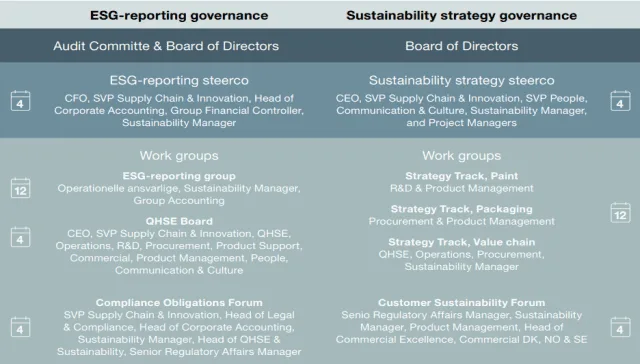
Sustainability Strategy Steerco
Flügger’s work with sustainability is anchored with the Board of Directors (assisted by the Sustainability Strategy Steerco) and the Audit Committee (assisted by the ESG-reporting Steerco). Thus the Sustainability Strategy Steerco leads customer focused initiatives on a strategic plan, while the ESG-reporting Steerco ensures ESG-compliance across Flügger. The participants and structure are illustrated below:
Commitments
Flügger recognizes the urgent need for climate action and is committed to reducing its environmental impact. As a Group, Flügger therefore strives to integrate sustainability across the entire value chain to contribute to a low-carbon economy.
To ensure that responsibility for the climate and environment remains a core consideration in all of Flügger’s business activities, Flügger is committed to the following:
- Reach net-zero emissions across its value chain by 2050, supported by short-term reduction targets.
- Develop products with an enhanced environmental profile and for the benefit of the customers.
- Minimize waste generation, air pollution, and water consumption through efficient resource management and sustainable practices.
- Enhance refurbishment and recycling by optimizing material use, as well as extending product life cycles, and promoting responsible end-of-life solutions.
- Mitigate climate related negative impacts and financial risks identified (as applicable) in Flügger’s latest double materiality assessment.
- Utilize and maximize the climate related positive impacts and financial opportunities identified in Flügger’s latest double materiality assessment.
- Maintain certifications and broaden scope of sites being ISO9001, ISO14001 and FSC certified.
- Comply with applicable laws and regulations at all times.
As a result of setting targets and embedding considerations for the environment and the climate into our business strategies and activities, Flügger consistently reduce its environmental impact. Furthermore, we report on our strategic sustainability priorities and environmental impact in our annual report here.